When we covered Vietnam’s consumption trends a few weeks ago, our perspective was based on insights shared by leading retailers and industry experts in early February. In this note, we revisit the topic from a different angle – that of household businesses, a key but often overlooked part of the private economy. Combined with the latest updates in April, we aim to provide a more complete view of Vietnam’s consumption dynamics. Understanding this segment is important, as it highlights both the scale of Vietnam’s informal economy and the ongoing shift toward more formal, compliant retail models, which supports long-term growth for modern consumer businesses.
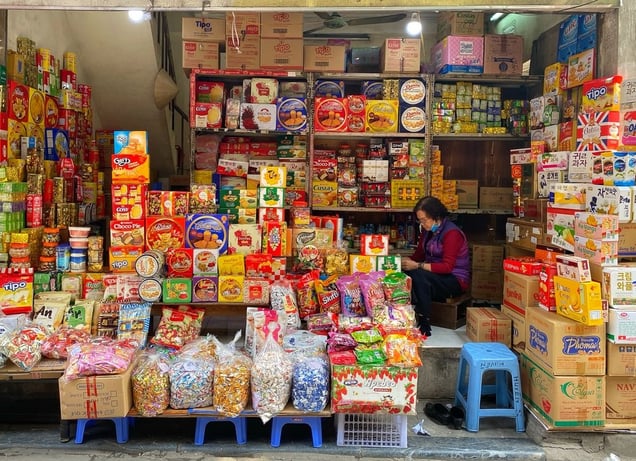 Mom-and-pop grocery shops, a typical household business in Vietnam.
The Informal Economic Driver
To begin with, Q1/2026 economic data continues to indicate a recovery in domestic demand. According to the National Statistics Office, GDP grew 7.8% year-over-year (YoY), with retail sales increasing 10.9% and public investment up nearly 40%. These figures reflect resilient domestic activity despite higher inflation linked to global oil supply disruptions. While useful at a high level, they do not fully capture how consumption takes place across the economy.
In practice, a large share of daily spending in Vietnam flows through small, locally operated businesses. According to Resolution 68 on private sector development issued 12 months ago, Vietnam’s private sector includes nearly one million small enterprises and over 5 million household businesses (the number of household businesses was estimated at around 6.1 million by the end of 2025). Together, they contribute approximately 50% of GDP, more than 30% of state revenue, and over 80% of total employment, as stated in the resolution. This highlights the scale of Vietnam’s informal economy and the central role household businesses play in both employment and consumption.
This is why household businesses deserve closer attention. Compared to small enterprises, which are formally registered with clearer governance and reporting standards, household businesses are typically smaller, family-run operations such as street-side food stalls, mom-and-pop grocery stores, mini serviced apartments, local craft producers, and neighborhood service providers. This segment may appear informal, but it plays a central and culturally embedded role in how income is generated and how Vietnamese people spend in everyday life.
However, this structure is changing rapidly. Stricter regulations and increasing formalization are gradually shifting consumption toward larger, compliant businesses with stronger operational standards. This transition creates significant opportunities for scalable consumer companies that can meet rising expectations around pricing transparency, product quality, customer experience, and regulatory compliance as Vietnam’s retail environment continues to modernize.
Transition in the Modern Consumer Market
Despite the scale of household businesses / informal businesses, this part of the economy is still adjusting to a more formal operating environment. While household businesses have expanded steadily since the 1986 Doi Moi reforms, the private sector was only formally recognized as a key economic driver last year under Resolution 68. Operators are now required to comply with new standards around taxation, invoicing, and business registration. Legal and policy-related issues remain the most significant constraint during this transition.
A recent survey conducted by the Vietnam Chamber of Commerce and Industry (VCCI) between February and April 2026 highlights this issue. Among more than 1,000 household businesses surveyed, over 73% reported that compliance requirements had a major or severe impact on their operations. This comes alongside new regulations and Vietnam’s major administrative restructuring last year, which merged various government bodies and briefly disrupted their public-facing functions. In the short term, these changes have created operational friction as businesses adjust to new requirements.
At the same time, recent government measures indicate a more gradual implementation approach, including the National Assembly’s decision to raise the tax-exempt revenue threshold for household businesses. While this reduces short-term pressure on smaller operators, it does not change the broader direction of the market. Formalization, stricter compliance, and improved governance remain necessary steps for Vietnam’s continued economic development, supporting higher product quality, better consumer safety, and a more sustainable tax base.
Pushback from household businesses is not unexpected, and similar transitions in other developing markets have also faced resistance. These changes are necessary for Vietnam to continue improving living standards and building a more transparent and efficient consumer economy. At Kenno, we accept a gradual pace of reform, as abrupt adjustments could negatively affect employment and consumption in the short term. However, our view remains clear: as regulatory standards tighten, smaller informal businesses will gradually lose market share to more structured and compliant players. This creates favorable market conditions for scalable, listed consumer companies to grow.
Kenno’s Perspective
Household businesses have historically provided a livelihood for a large part of Vietnam’s workforce, but their role is gradually declining as modern trade gains share. This shift is being driven by tighter enforcement of taxation, e-invoicing, and product standards, alongside broader market development. While this creates short-term pressure for parts of the informal sector, it is a necessary step toward a more efficient and higher-quality growth model.
Vietnam continues to pursue strong economic growth, supported by urbanization, rising incomes, and a clear policy focus on private sector development and foreign investment. As the market evolves, informal businesses will either adapt to new standards or gradually exit, with employment shifting toward more structured companies. From a consumption perspective, what matters is that income and employment remain intact – and often improve – as the economy modernizes.
This transition is positive for investors. Companies that operate at scale, meet regulatory standards, and offer consistent product quality are well positioned to benefit as the market becomes more formalized. This is reflected in our investment portfolio, which focuses on consumer businesses whose strategies are aligned with this structural shift, such as branded food manufacturer and consumer platform Masan Group (MSN), electronics and grocery retailer Mobile World Corporation (MWG), and Long Chau, the modern pharmacy chain operated by FPT Retail (FRT). These are among the largest and fastest-growing consumer businesses in Vietnam.
The Kenno Vietnam Fund invests in high-quality companies focused on Vietnam’s domestic consumption and resilient economic growth. We actively engage with our holdings to support consistent earnings growth and deliver competitive returns to our investors. If you are looking for exposure to one of Asia’s fastest-growing economies, feel free to reach out to us.