Vietnam’s real estate market is moving toward a clearer balance between supply and actual housing demand. While higher interest rates have slowed transaction activity, demand remains supported by urbanization and income growth. At the same time, tighter financing conditions are limiting new supply from weaker developers, helping reduce excess inventory and improve overall market quality.
As part of this mini-series, we previously covered Vietnam’s macro and consumer trends based on our discussions at the Vietnam Access Days (VAD) 2026 conference. In this article, we draw on insights from a panel discussion among CBRE, Vinhomes, and our portfolio company Nam Long Group (NLG), together with the latest on-the-ground observations from our Investment team. We assess how these changes are shaping the sector, improving earnings visibility for property developers, and supporting investor confidence.
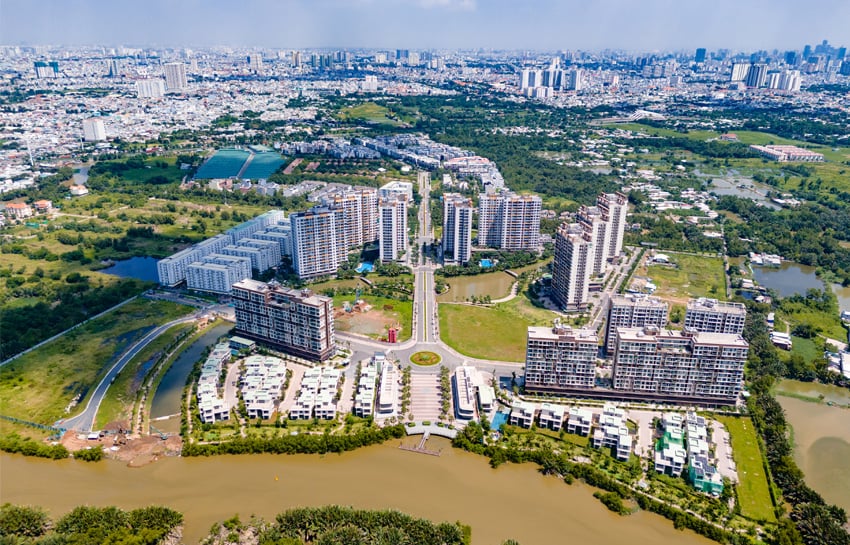 Mizuki Park – an integrated township project by Nam Long Group (NLG) on the outskirts of Ho Chi Minh City
Market Structure Improves as Supply Becomes More Controlled
One of the main takeaways from the Real Estate panel at VAD was that the structure of Vietnam’s real estate market has improved compared to previous cycles, with the regulatory framework now significantly clearer than in the pre-2020 period. In earlier cycles, project launches were often driven by expectations of rising prices, which led to supply building up ahead of demand. Today, higher price levels – with residential prices increasing by 20–30% year-over-year (YoY) in 2025, estimated by the Ministry of Construction – have slowed speculative transaction activity, leading developers to take a more cautious approach to new launches and reducing the risk of excess supply entering the market at the wrong time.
According to CBRE Vietnam’s Executive Director and Head of Professional Services, Dung Duong, the current situation is not a broad oversupply, but a mismatch between segments. Supply has increased in the luxury and high-end segment, while affordable and mid-income housing remains limited. CBRE Vietnam’s latest report shows more than 4,000 residential units were launched in Ho Chi Minh City in Q1/2026 (+93% YoY) but only 42% were priced below VND 60 million per square meter (approximately USD 2,400 per sqm), which broadly falls within the mid- to lower-end segment. This indicates that most new supply continues to be concentrated in higher price brackets, while demand remains stronger in more affordable segments.
Looking ahead, Vietnam’s pre-sales model is expected to further support supply control. Developers typically secure buyers before construction begins, collecting around 20% of project value upfront. This allows them to delay projects if demand weakens, rather than continuing to build unsold units. Compared to build-first markets, this approach helps reduce the risk of oversupply and gradually brings supply closer to real demand.
At the same time, improving transport infrastructure is expanding where development can take place, driving a shift from city centers to well-connected suburban and satellite locations. With more highways, ring roads, and transport links being built, residential projects are increasingly located outside central districts, allowing developers to offer more accessible housing while maintaining urban connectivity. Recent regulations also allow private developers to take a more active role in building supporting infrastructure, reducing reliance on government execution.
Demand Remains Intact with a Clear Shift Toward End Users
Even as homebuyer sentiment has softened in the short term due to rising prices, demand continues to be supported by structural factors, including population growth, continued urban migration, and rising incomes across major economic regions. Panelists at VAD also reported changes in homebuyer preferences, with increasing demand for cleaner environments, more space, and better amenities.
Infrastructure investment also supports demand by making these areas more practical for homebuyers. According to the Ministry of Finance, public investment disbursement reached approximately USD 33 billion in 2025, the highest level in the 2021–2025 period, and this momentum has carried into 2026 with strong first-quarter growth of 45%. Improved connectivity increases access to jobs, services, and amenities, making suburban locations more viable places to live. This supports broader economic growth and domestic consumption over time, particularly as improved connectivity expands access to jobs and services.
VAD’s Real Estate panel also highlighted an important shift in the buyer profile, specifically the decline in speculative activity. Historically, a large portion of transactions came from investors seeking short-term gains, with speculative activity accounting for up to 50–70% of buyers in certain markets, according to CBRE Vietnam’s Dung Duong. In the current cycle, the majority of buyers are end users or long-term investors, with developers such as NLG reporting that 70–80% of their buyers are purchasing homes for personal use rather than resale, according to NLG’s Group CEO, Lucas Loh. Going forward, this points to lower pricing volatility, a more stable demand base, and a stronger focus on affordable and social housing segments.
An Opportune Setup for Well-Established Developers
Property prices in Vietnam are currently estimated to stand at 25–30 times average annual household income, around twice the global average. This gap highlights the scale of unmet demand in the affordable and mid-income segments, where pricing remains a key barrier for most homebuyers. In the current environment, developers that focus on genuine end-user demand, particularly for lower-income housing, and maintain strong execution are better positioned to grow.
Financing conditions have tightened compared to previous years, but the impact is more visible in transaction timing than in underlying demand. Vietnam has historically operated in a higher interest rate environment, with lending rates averaging around 8–9% over the past decade. As rates have increased, buyers have become more cautious, leading to slower transaction volumes. In response, developers have adjusted by negotiating with banks to offer structured financing packages, including fixed-rate periods in the early years, which provide more certainty around repayment costs and support affordability even as interest rates rise, particularly in segments driven by real housing needs.
For well-established developers like NLG and Vinhomes, capital access is currently secure with no systemic financing risk, supported by long-standing banking relationships and, in some cases, access to international funding sources. Meanwhile, banks are more cautious toward weaker players, creating a clearer separation within the market, where high-quality developers have advantages in execution and maintaining project pipelines.
Kenno’s Perspective
Vietnam’s real estate market is becoming less dependent on speculative activity, with outcomes increasingly determined by affordability, execution, and project quality. From an investment perspective, this backdrop reinforces our outlook for NLG in terms of clearer earnings visibility, given its direct exposure to genuine housing demand.
The developer focuses on the affordable and mid-income housing segments (below USD 2,500 per sqm), where demand remains underserved. Its projects include condominiums and townhouses in suburban areas, with pricing and locations suited to end users. Supported by bank-backed financing packages, this positioning allows the company to maintain steady sales even in a higher interest rate environment.
For 2026, while management targets much stronger pre-sales growth, we take a more conservative view of around 60% given tighter credit conditions and lower market liquidity. Even under these assumptions, earnings visibility remains supported by the delivery of previously sold projects, providing a more stable and predictable revenue base.
For more topics in the “Kenno at VAD 2026” series, please visit our blog section. Most recently, we covered trends in Vietnam’s consumer market. If you have any questions or would like to discuss investing in Vietnam, feel free to reach out to us.